Kitchen Conversion Chart
All the must-know kitchen conversions on one page: cups to tablespoons, fluid ounces and mL; everyday ingredient weights in grams; oven temperatures; butter sticks; ounces to grams. Built to print — hit the button and it comes out as a clean one-page chart for the fridge or recipe binder.
Free to print and share — black-and-white friendly, fits one page.
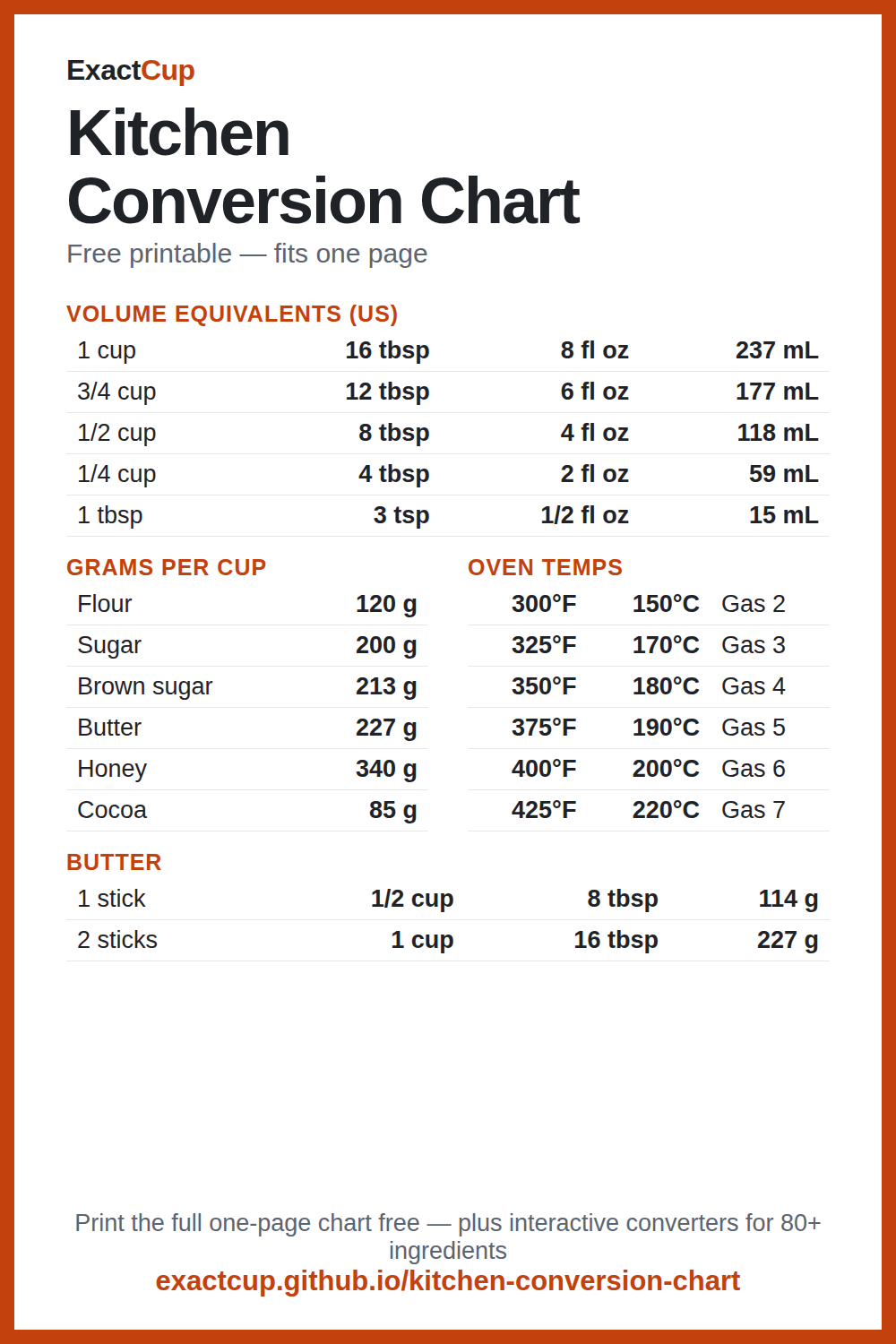
Volume equivalents (US)
| Cups | Spoons | Fl oz | mL |
|---|---|---|---|
| 1 cup | 16 tbsp | 8 fl oz | 237 mL |
| 3/4 cup | 12 tbsp | 6 fl oz | 177 mL |
| 2/3 cup | 10 tbsp + 2 tsp | 5 1/3 fl oz | 158 mL |
| 1/2 cup | 8 tbsp | 4 fl oz | 118 mL |
| 1/3 cup | 5 tbsp + 1 tsp | 2 2/3 fl oz | 79 mL |
| 1/4 cup | 4 tbsp | 2 fl oz | 59 mL |
| 1/8 cup | 2 tbsp | 1 fl oz | 30 mL |
| 1 tbsp | 3 tsp | 1/2 fl oz | 15 mL |
| 1 tsp | 1/3 tbsp | 1/6 fl oz | 5 mL |
Cups, pints, quarts & gallons
| 1 gallon | 4 quarts | 16 cups | 3.79 L |
| 1 quart | 2 pints | 4 cups | 946 mL |
| 1 pint | 2 cups | 16 fl oz | 473 mL |
| 1 cup | 1/2 pint | 8 fl oz | 237 mL |
Butter
| Sticks | Cups | Tbsp | Grams |
|---|---|---|---|
| 1/2 stick | 1/4 cup | 4 tbsp | 56.8 g |
| 1 stick | 1/2 cup | 8 tbsp | 113.5 g |
| 2 sticks | 1 cup | 16 tbsp | 227 g |
| 4 sticks (1 lb) | 2 cups | 32 tbsp | 454 g |
Ingredient weights (1 US cup)
| Ingredient | Grams | Ounces |
|---|---|---|
| All-Purpose Flour | 120 g | 4.2 oz |
| Bread Flour | 120 g | 4.2 oz |
| Cake Flour | 120 g | 4.2 oz |
| Whole Wheat Flour | 113 g | 4 oz |
| Granulated Sugar | 200 g | 7.1 oz |
| Brown Sugar (packed) | 213 g | 7.5 oz |
| Powdered Sugar | 113 g | 4 oz |
| Butter | 227 g | 8 oz |
| Milk | 240 g | 8.5 oz |
| Heavy Cream | 232 g | 8.2 oz |
| Vegetable Oil | 218 g | 7.7 oz |
| Honey | 340 g | 12 oz |
| Maple Syrup | 322 g | 11.4 oz |
| Cocoa Powder | 85 g | 3 oz |
| Cornstarch | 112 g | 4 oz |
| Rolled Oats | 90 g | 3.2 oz |
| White Rice (uncooked) | 185 g | 6.5 oz |
| Chocolate Chips | 170 g | 6 oz |
Oven temperatures
| °F | °C | Gas mark |
|---|---|---|
| 250°F | 120°C | Gas 1/2 |
| 275°F | 140°C | Gas 1 |
| 300°F | 150°C | Gas 2 |
| 325°F | 170°C | Gas 3 |
| 350°F | 180°C | Gas 4 |
| 375°F | 190°C | Gas 5 |
| 400°F | 200°C | Gas 6 |
| 425°F | 220°C | Gas 7 |
| 450°F | 230°C | Gas 8 |
| 475°F | 240°C | Gas 9 |
Fan/convection oven: reduce by about 20°C (25°F).
Ounces to grams
| 1/2 oz | 14 g |
| 1 oz | 28 g |
| 2 oz | 57 g |
| 4 oz (1/4 lb) | 113 g |
| 8 oz (1/2 lb) | 227 g |
| 12 oz (3/4 lb) | 340 g |
| 16 oz (1 lb) | 454 g |
Ingredient weights are nominal — how you fill the cup matters, so weigh when accuracy counts. Free chart by ExactCup · interactive converters for 80+ ingredients at exactcup.github.io/kitchen-conversion-chart/
How to use this chart
The volume table is universal — 1/2 cup is 8 tablespoons whether it holds milk or flour, because those are all volume units. The ingredient weights table is the one that changes per ingredient: it gives the weight in grams of one level US cup, using the same verified densities as our cups to grams converter (which covers 80+ ingredients and every fraction of a cup, both directions). For brown sugar that means packed into the cup; for flour, spooned in and leveled — scooping straight from the bag compacts flour by up to 30%, which is why serious bakers weigh instead.
Halving a recipe and stuck on half of 3/4 cup? That is its own chart: the recipe halving chart. Scaling the whole ingredient list, use the recipe scaler; converting an oven recipe for the air fryer, the air fryer converter. The butter rows come from the butter converter, which also handles odd amounts like 1 1/2 sticks in grams, and the temperature rows from the oven temperature converter.
Pin or share this chart
Want this on your own site?
The interactive version of this chart is free to embed — one HTML snippet adds a live cups↔grams converter to any recipe post. And the ingredient densities behind it are published as an open dataset (CC BY 4.0), free to reuse with attribution.
Frequently asked questions
How many tablespoons are in a cup?
There are 16 US tablespoons in a cup, and 3 teaspoons in a tablespoon (48 teaspoons per cup). So 3/4 cup is 12 tablespoons, 1/2 cup is 8, and 1/4 cup is 4. The awkward ones are the thirds: 1/3 cup is 5 tablespoons + 1 teaspoon and 2/3 cup is 10 tablespoons + 2 teaspoons.
How many mL are in a cup?
A US cup is 236.588 mL — 237 mL in practice, and US nutrition labels round it to 240 mL. The metric cup used in the UK, Australia and New Zealand is 250 mL, about 5% bigger, which matters over several cups.
Why is a cup of flour 120 g but a cup of honey 340 g?
Because a cup measures volume, not weight, and every ingredient has a different density. That is why the ingredient table on this chart lists a separate gram weight per cup for each ingredient — one cups-to-grams number for all ingredients does not exist.
How do I print this chart?
Click the Print button at the top (or press Ctrl+P / Cmd+P). The page is print-optimized: the site header, footer and everything below the chart are stripped automatically, and the tables flow into two columns so the whole chart fits on one portrait page in plain black and white.
Is this chart free to print and share?
Yes — print it for your kitchen, classroom, cookbook club or commercial kitchen, and share copies freely. If you republish it online, please credit ExactCup with a link; the underlying ingredient-density data is open under CC BY 4.0.
Are these US or UK measurements?
The cups, tablespoons and fluid ounces are US customary (UK and US tablespoons are both 15 mL, but the Australian tablespoon is 20 mL). For UK cooks the chart includes gas marks in the oven table and grams everywhere; note the UK/Australian metric cup is 250 mL rather than the US 237 mL.